Bring order, clarity, and control to your OT operations.
The OT-facing side of Portainer. A workspace for operators, technicians, and automation engineers to deploy and run containerized applications across sites, lines, and devices without touching the infrastructure beneath.
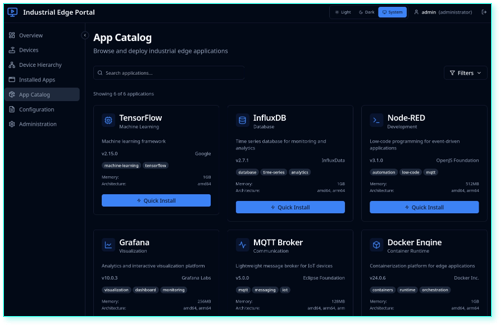
Two audiences, one platform. Two interfaces.
Your IT team needs a control plane. Governance, policies, fleet-wide visibility, deep infrastructure access. Your OT team needs none of that. They need to deploy a known-good application to a known device, see if it's running, and get back to the work in front of them.
Forcing operators into IT tooling is how good rollouts stall. Wrong language. Wrong abstractions. Wrong defaults. The Industrial App Portal exists so the people on the floor get an interface built for the work they actually do, while the people governing the fleet keep the controls they need.
Built for the floor. Connected to the fleet.
Distributed OT, one workspace
One portal across every plant, every business unit, every Portainer Server.
Built around OT constructs
Hierarchies, device groups, and language your teams already use.
RBAC at every level
Permissions inherited from the Portainer operator control plane.
Controlled, repeatable deployments
Pre-approved apps. Target hierarchies or individual devices. Per-device variable exceptions when sites need them.
Real-time operational visibility
Service health, connectivity, resource usage. Drill in to diagnose or restart without leaving the portal.
One platform. Two interfaces. One story.
Portainer gives your IT team an operator control plane for Docker, Podman, and Kubernetes across the entire industrial fleet.
The Industrial App Portal is the OT-facing layer on top of that platform. Same governance. Same identity. Same RBAC. A different interface, built for a different job.
See this architecture in production. GE Appliances at ProveIt →
Three roles. One way in.
Controls & automation
Engineers on the front lines. Factory floor, fleet, remote sites.
Enterprise IT & DevOps
Teams supporting industrial edge operations.
System integrators
Deploying standardized solutions where uptime matters most.
Give your OT teams a workspace built for the floor.
See how the Industrial App Portal extends the Portainer deployment you already run, and gives every site, role, and device its own way in.